
Red Teaming - Realistic Attack Simulations
You can never know how secure your own systems are until they are attacked. Our Red Team experts help you prepare for attacks to plan future security initiatives.
References






Certificates


Advanced Persistent Threat
What is Red Teaming?
Red Teaming is used to test an organization's detection and response capabilities. Our Red Team attempts to access sensitive information in every conceivable way and as undetected as possible. This assessment emulates a malicious actor who is actively attacking and trying to evade detection, similar to an Advanced Persistent Threat (APT) or a cyber threat.
Red Teaming originated in the US military sector and was developed to critically examine defense strategies through realistic enemy simulations. The goal: to test and improve the effectiveness of one's own security measures by simulating attacks and adopting an enemy perspective. This structured approach was later transferred to the field of cybersecurity.
Levels of Abstraction
Differences between Red Teaming and Penetration Testing
The decision whether to conduct a pentest or deploy a Red Team can only be made in conjunction with your own objectives. Our Red Team attempts to access sensitive information in every conceivable way and as undetected as possible. This assessment emulates a malicious actor who is actively attacking and trying to evade detection, similar to an Advanced Persistent Threat (APT) or a cyber threat.
- Searching for vulnerabilities to achieve the goal
In a Red Team Assessment, the goal is not to find multiple vulnerabilities, but to find the vulnerabilities that can be used to achieve the objectives.
- No detailed listing of vulnerabilities
A pentest, on the other hand, aims to uncover as many vulnerabilities and configuration issues as possible, exploit these, and determine the risk level. The methods used by the Red Team include social engineering, electronic and physical pentests, and all methods generally used in a security assessment.
- Longer project duration and preparation time
Red Teaming operations have defined objectives and simultaneous procedures. They often require more people, resources, and time, as they delve deep to fully understand the realistic extent of risks and vulnerabilities in relation to an organization's technology, people, and material resources.
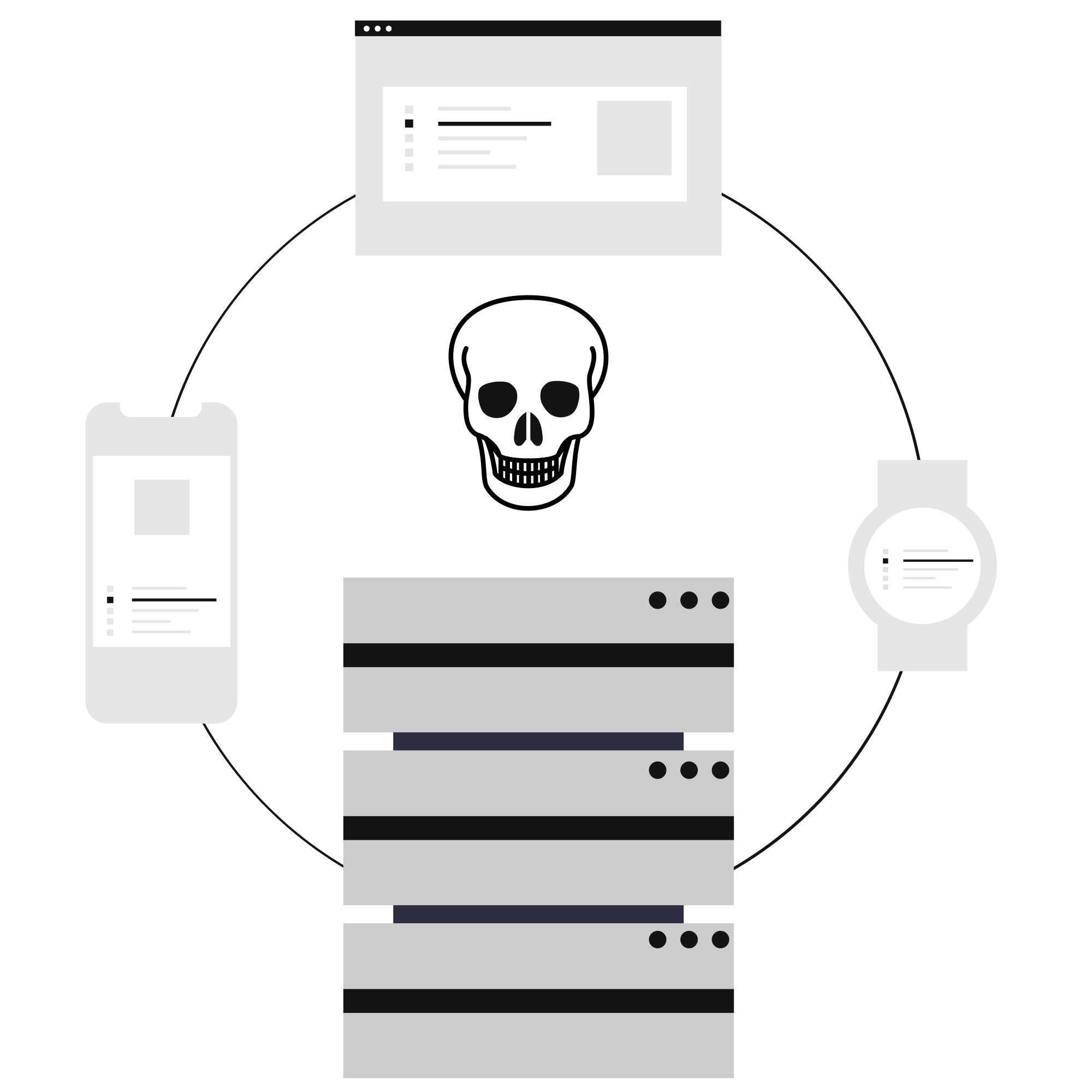
Also called attack simulation
When should Red Teaming be Used?
An attack simulation is a realistic simulation of a real attack, which takes into account not only technical but also human security factors that conventional pentests do not include. All digital and analog processes from a company's IT security management are put to the test, and attempts are made to access sensitive information in every conceivable way and as undetected as possible. This provides you with valuable insights, from prevention to detection and response, and achieves a sensitization of the responsible employees.
- Measurable Detection and Response Capability of IT Security
- Realistic Risk Understanding for the Organization
- Assistance in mitigating identified attack vectors
- Gathering insights on attack methods
- Testing the Response of IT Processes

Range of Services for Cyber Security
Additional meaningful services within the scope of an IT security audit
- Penetration Test
Penetration tests are simulated attacks from external or internal sources to determine the security of web applications, apps, networks, and infrastructures and to reveal any vulnerabilities.
- Cloud Security
Due to the increasing complexity of cloud infrastructures, many services are incorrectly configured. We help you identify and eliminate misconfigurations and their effects.
- Phishing Simulation
A spear-phishing simulation is used to enhance the detection capabilities of your employees. We help you sensitize your staff, thereby strengthening the last line of defense.
- Static Code Analysis
Static code analysis, also known as source code analysis, is typically conducted as part of a code review and takes place during the implementation phase of a Security Development Lifecycle (SDL).
Which Tools and Techniques are used?
Among the most important tools in Red Teaming are AptSimulator, Atomic Red Team, and Caldera. Other frequently used tools in Red Teaming include Metasploit for exploits, Cobalt Strike for post-exploitation, BloodHound for Active Directory analysis, Burp Suite for web applications, and the Social-Engineer Toolkit for targeted social engineering attacks.
- AptSimulator
The Windows-based tool simulates typical traces and activities of advanced attackers (APT). It deliberately creates artifacts and system changes to test the detection and response capabilities of IT security teams. AptSimulator is particularly suitable for testing the effectiveness of forensic and monitoring solutions against known attack patterns.
- Atomic Red Team
The framework provides small, targeted tests ("atomic tests") that simulate individual tactics, techniques, and procedures (TTPs) from the MITRE ATT&CK Framework. Companies can use this to specifically check whether their security controls detect and defend against certain attack paths. Atomic Red Team allows for the customization of tests to industry-specific threats and supports regular, continuous reviews of their own defense measures.
- MITRE Caldera
The automated platform emulates attackers and supports manual Red-Team operations. Caldera is based on the MITRE ATT&CK Framework and allows orchestrating complex attack scenarios with various plugins and agents. The platform is suitable for automating Adversary Emulation, supporting Incident Response exercises, and visualizing attack paths.

Current Information
Recent Blog Articles
Our employees regularly publish articles on the subject of IT security


Contact
Curious? Convinced? Interested?
Schedule a no-obligation initial consultation with one of our sales representatives. Use the following link to select an appointment: